Electricity
Atomic Structure
- An atom has a positively charged nucleus and negatively charged electrons revolving around it.
- Valence electrons in metals are free to move within the conductor and constitute an electric current.
Charge
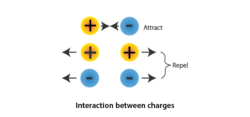
The charge is an intrinsic property of matter by virtue of which it can exert electromagnetic force.
Conductors and Insulators
A substance which offers comparatively less opposition to the flow of current is known as a conductor, and substances which offer larger opposition are called insulators.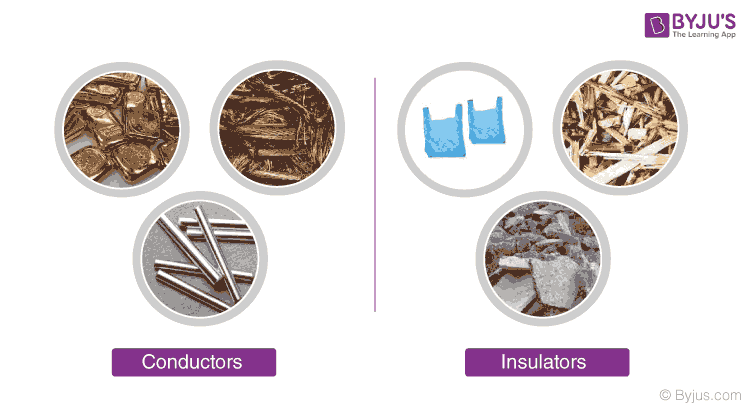
Some examples of conductors include copper, iron and steel. Some of examples of insulators include glass, dry wood and cotton.
Electric Potential and Potential Difference
The electric potential at a point is defined as work done in bringing a unit positive charge from infinity to that point. The potential difference between two points is defined as the difference in electric potentials at the two given points. The electrons move only if there is a difference in electric pressure called the potential difference. One Volt is defined as energy consumption of one joule per electric charge of one coulomb.
Mathematically, electric potential between two points is given as:
where V is the potential difference, W is the work done, Q is the electric charge.
Electric Current(I)
Flow of electric charges is called electric current, i.e, I = Q / t
Models of Electric Current
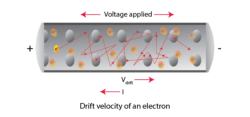
Drift Velocity of Electron
It is the average velocity that an electron attains inside a metallic conductor due to the application of an electric field due to the potential difference.
Battery and Its Working
A cell is a source of potential difference, which is created inside it due to internal chemical reactions.
At anode: Cu(s)⇌Cu2+(aq)+2e−
At cathode: Ag(aq)+2e−⇌2Ag(s)
A combination of cells is called a battery.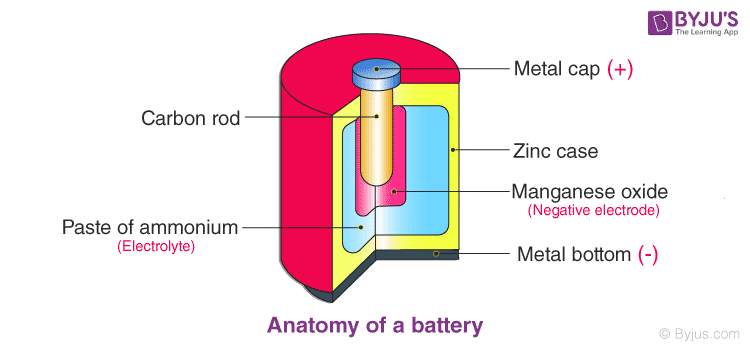
Electric Circuit
Electric Circuit and Circuit Diagram
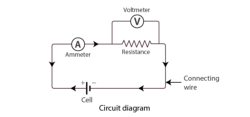
- A closed-loop path which a current takes is called an electric circuit.
- The representation of an electric circuit through symbols is called a circuit diagram.
Comments
Post a Comment