ohm's law
Resistance and Ohm’s Law
Ohm’s Law
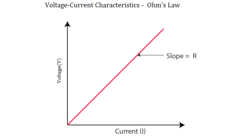
The current flowing through an ohmic conductor is directly proportional to the applied potential difference between the two ends of the conductor. Ohm’s Law states the relationship between the potential difference across a conductor and the current through it
Resistance
Resistance is a measure of the opposition offered to the current flow in an electric circuit. Resistance is measured in ohms. All materials resist current flow up to some degree. All materials fall into one of two broad categories: Conductors and Insulators.
Factors Affecting Resistance & How They Affect
Resistance is:
- Directly proportional to the length of the conductor.
- Directly proportional to the nature of the conductor.
- Directly proportional to the temperature of the conductor.
- Inversely proportional to the cross-sectional area of the conductor.
Resistivity
The electrical resistance offered by a substance of unit length and unit cross-sectional area is called resistivity.
Ohmic and Non-Ohmic Resistors
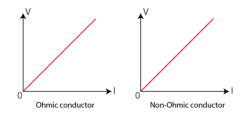
Resistors which follow Ohm’s Law are called Ohmic resistors, and those which do not follow it are called Non-Ohmic resistors.
Superconductors
Conductors which offer zero resistance to the flow of current are called superconductors. Prominent examples of superconductors include aluminium, niobium, magnesium diboride, and cuprates such as yttrium barium, copper oxide and iron pnictides.
Combination of Resistors
Combination of Resistors
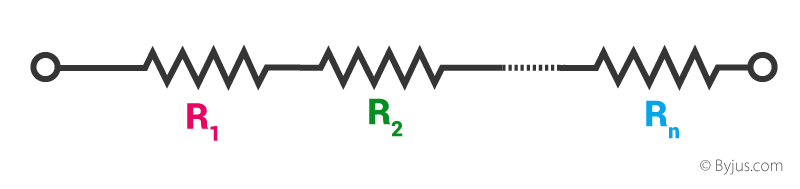
- Two resistors are said to be combined in series if they carry the same current.
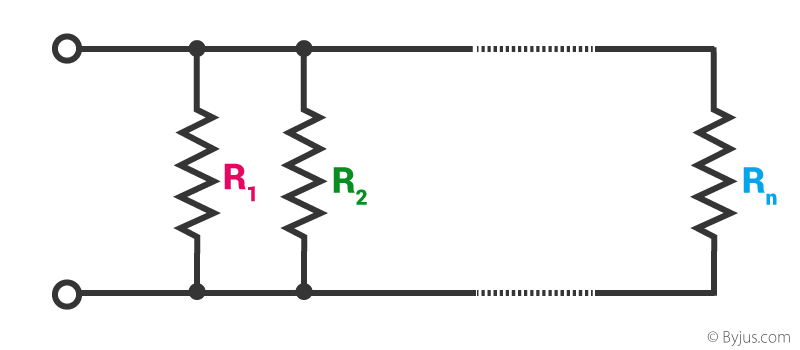
- Two resistors are said to be combined in parallel if the same potential difference is applied to them.
Equivalent Resistance of a System of Resistors
The equivalent resistance of two resistors is given as:
- In series, Req=R1+R2
- In parallel, 1/Req= 1/R1+ 1/R2
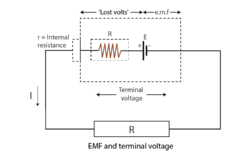
EMF and Terminal Voltage
- EMF: The potential difference between the two terminals of a cell when there is no current flowing through the circuit.
- Terminal voltage: The potential difference between the two terminals of a cell when current is flowing through the circuit.
Electric Power and AC
Heating Effect of Current
Joule’s Law:
- Heat (H) ∝ square of the current (I).
- H ∝ Resistance of the given circuit.
- H ∝ Time (t) for which current flows through the conductor.
When a potential difference is established, it causes electrons to move, i.e. flow of current.
Uses of Heating Effect of Electric Current
The heating effect of current is applied in the working of electrical heating appliances such as electric kettles, electric iron, room heaters, water heaters (geysers), etc.
Electric Power
- The rate of doing work or the rate of consumption of electrical energy is called Electric Power. If W is work done in time t, then P=W/t.
- S.I. unit is Watt(W). One watt of power is consumed when 1 A of current flows at a potential difference of 1 V.
- The commercial unit of electrical energy is a kilowatt-hour (kWh).
- 1kWh = 3,600,000J = 3.6×10⁶J
- Represented as P=I2R and P=V2/R.
- One kilowatt-hour is defined as the amount of energy consumed when 1kW of power is used for 1 hour
Comments
Post a Comment